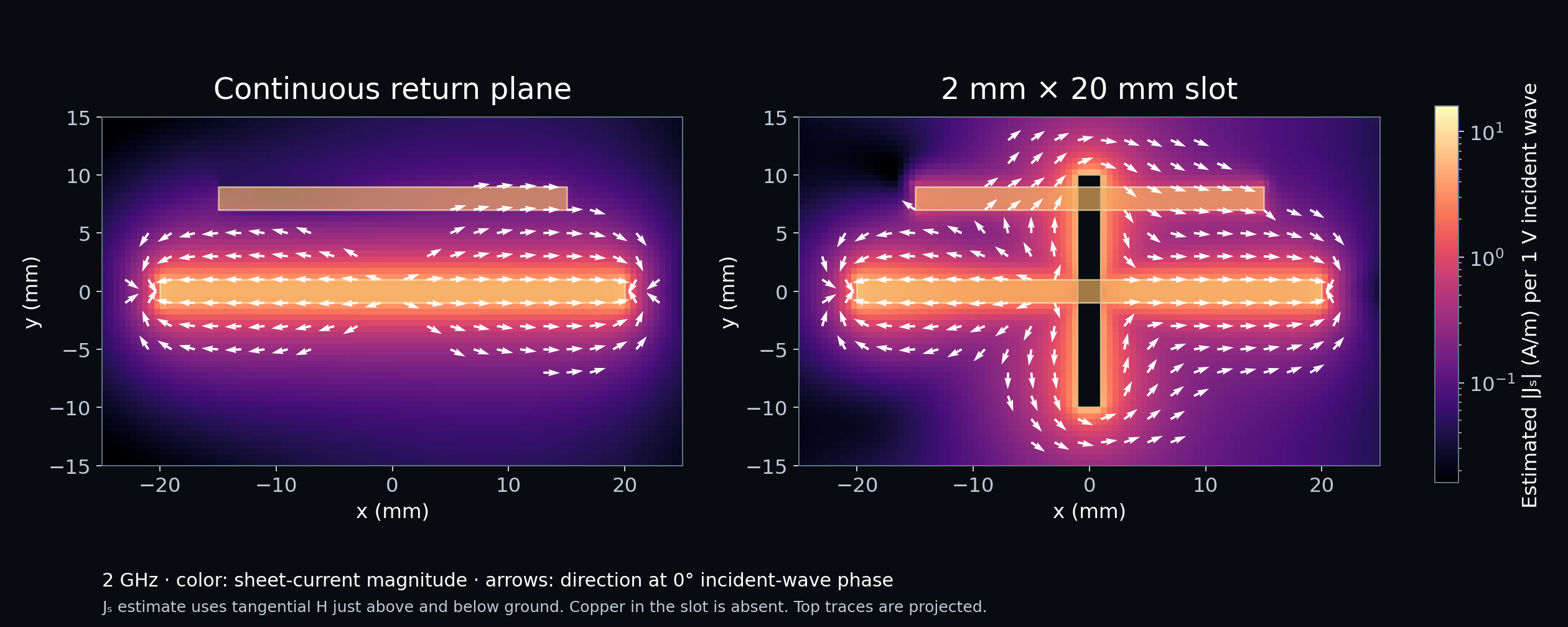
Actual openEMS results from 100 MHz to 3 GHz. Continuous ground is on the left; the slotted plane is on the right. Start with the 2 GHz current map, then rotate both views or inspect fields below ground.
For the slot, select Ground-current estimate and Top view. Color shows the magnitude of the estimated sheet current on the ground. The slot contains no conductor. White arrows have equal lengths and show direction at the selected phase relative to a 1 V incident wave. Phase changes direction, while magnitude stays fixed. Arrow graphics sit slightly above the plane for visibility.
The estimate uses Jₛ = ẑ × (H above − H below), sampled just to either side of ground. Finite sampling offsets and interpolation limit accuracy near edges. It is a diagnostic of the return path, not a direct exact boundary-current dump. Cells and arrows in the actual slot are omitted because there is no metal there.
For aperture leakage, select Electric field with a horizontal slice just below z = 0 mm. A magnitude surface in the air does not have to contain a gap matching the copper slot. Each quantity has one common scale across the solid/slot pair and all five frequencies.
Copper comes from the solver XML. Ground is at z = 0 mm; top copper at z = 1 mm. PEC conductors have zero thickness, and the dielectric is lossless with εᵣ = 4.2. There is no vertical exaggeration. The frequency experiment enlarges the air box and keeps all field samples away from the absorbing boundary.
Frequency-sweep volumes use a 1 mm x/y display grid, with all saved z samples. Isosurfaces use additional display decimation. Current colors use 0.5 mm cells. The refined solve uses 0.25 mm cells around the slot, trace widths and dielectric. The project archive retains the raw solver files. Download the hosted numerical summary and mesh comparison under frequency data and provenance.
Experiment guide · Numerical comparison · Magnetic-field boundary condition